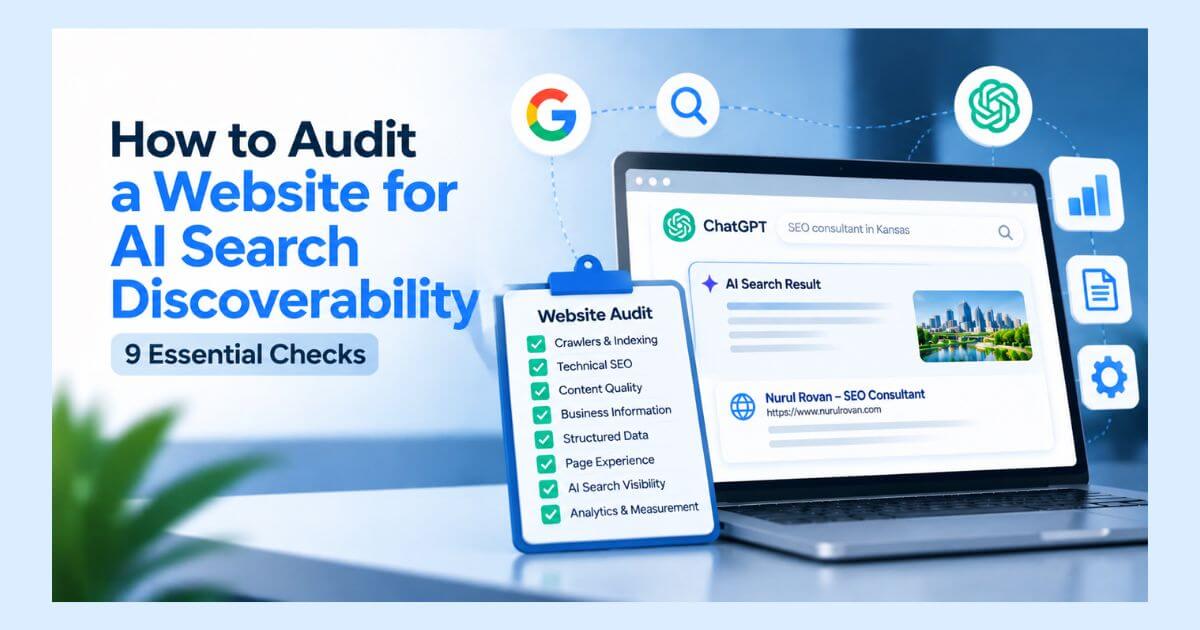
A business in Wichita, Kansas, has invested in its website, published helpful articles, and created dedicated pages for its services. Traditional SEO is part of its marketing strategy, but the owner now wants to understand whether the website is also accessible and useful across AI-powered search experiences.
The challenge is knowing where to start. Should the business change its content, add structured data, improve technical SEO, or focus on its brand information?
Without a systematic audit, it is easy to spend time on changes that make little difference.
An AI search discoverability audit evaluates whether a website is technically accessible, contains useful and understandable information, clearly communicates its expertise, and can be monitored across relevant AI-powered search experiences.
This guide explains nine practical checks for auditing a website for Google AI Overviews, Google AI Mode, ChatGPT Search, and broader AI-assisted discovery.
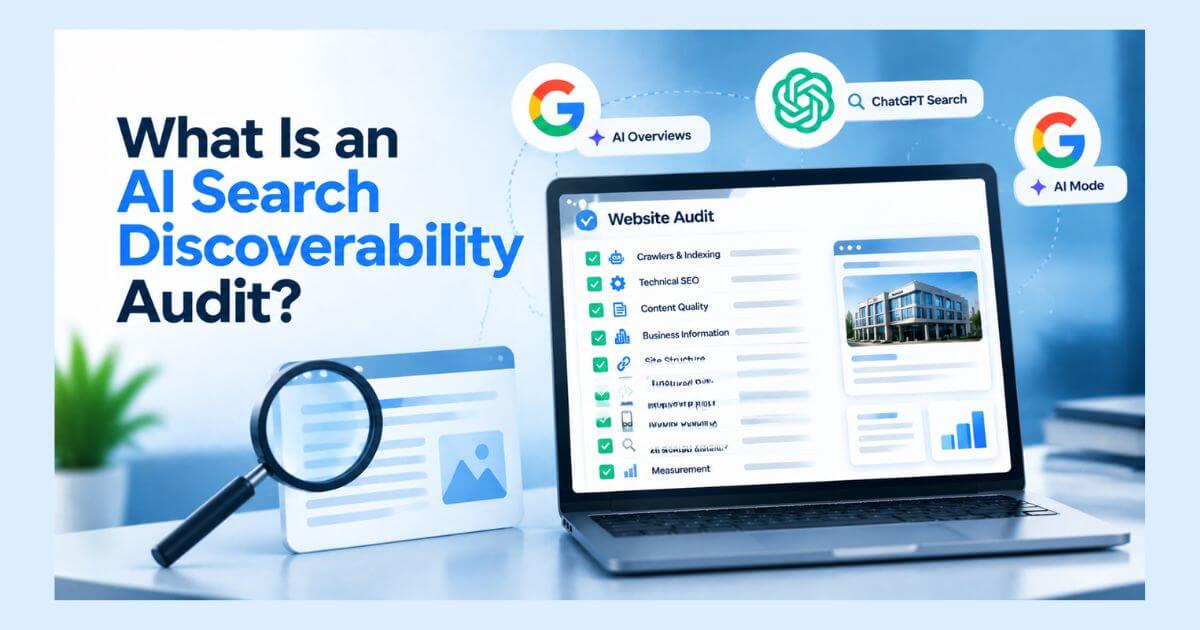
What Is an AI Search Discoverability Audit?
An AI search discoverability audit is a structured review of the factors that may affect how AI-powered search systems discover, interpret, and reference website information.
It builds on traditional SEO rather than replacing it.
Google’s official guidance confirms that established SEO practices remain relevant to AI Overviews and AI Mode. A page must be indexed and eligible to appear in Google Search with a snippet to qualify as a supporting link, although eligibility does not guarantee inclusion.
ChatGPT Search has its own discovery considerations, including access for OpenAI’s OAI-SearchBot.
A useful audit therefore examines technical accessibility, content quality, business entity information, website structure, and measurable performance.
1. Verify Search Crawler Access and Indexing Eligibility
Start by checking whether important website pages are accessible to the search systems you want to reach.
Review your robots.txt file and relevant indexing directives.
For Google Search, check whether Googlebot can crawl important pages and whether any unintended noindex directives prevent indexing.
For ChatGPT Search, review whether your robots.txt rules allow OAI-SearchBot to access the relevant public content.
Also investigate firewalls, content delivery networks (CDNs), and bot-protection tools that might block legitimate crawler requests.
What to check:
- Important pages are publicly accessible.
- robots.txt does not unintentionally block relevant content.
- Important pages do not contain accidental noindex directives.
- Key URLs return appropriate HTTP responses.
- Security settings do not unnecessarily block relevant crawlers.
For a Kansas chiropractic clinic, an inaccessible service page could limit its discoverability regardless of how useful the page content is.
Recommended tools: Google Search Console, URL Inspection, robots.txt, and server or CDN logs where available.
2. Identify Technical SEO Problems That Limit Discovery
A page may be accessible to visitors while still experiencing technical problems that affect crawling, indexing, or content processing.
Review your website for:
- Broken internal links and important 404 errors.
- Redirect chains and redirect loops.
- Incorrect canonical tags.
- Duplicate or conflicting URLs.
- Server errors on important pages.
- Essential content that is missing after JavaScript rendering.
Use a crawler such as Screaming Frog SEO Spider to examine internal URLs and identify potential problems. Then verify significant findings instead of treating every automated warning as an error.
For example, if a clinic’s appointment page redirects through several outdated URLs, correcting the redirect path and internal links may improve navigation and simplify crawling.
Action: Prioritize problems affecting important pages, rather than fixing every low-impact warning simply to produce a longer audit report.
3. Evaluate Content Quality and Search Intent
Technical accessibility is only one part of discoverability. Your website also needs information that genuinely helps its intended audience.
Review important pages and ask:
- Does the content answer a clear question or solve a real problem?
- Is the information accurate, relevant, and sufficiently detailed?
- Does it provide original insights or meaningful examples?
- Are factual claims supported by reliable sources where appropriate?
- Does the page offer something useful beyond a generic summary?
For a Kansas chiropractic practice, a service page should explain the relevant service accurately and help prospective patients understand what to expect. It should not rely on repetitive city names or unsupported health claims.
For Nurul Rovan, educational SEO articles should explain actual diagnostic processes, practical solutions, and the reasoning behind recommendations.
Action: Improve content where it lacks clarity, originality, accuracy, or useful detail. Do not rewrite an effective page solely to make it appear more AI-friendly.
4. Strengthen Your Business Entity and Expertise Signals
Search systems and potential customers need to understand who a business is, what it offers, and whom it serves.
Audit your About page, service pages, author information, and relevant business profiles.
Check whether your business name, services, location, professional background, and contact information are accurate and consistent.
For example, Nurul Rovan’s professional identity can be communicated through a clear relationship:
Nurul Rovan → SEO Consultant → AI Search Optimization Specialist → Kansas Businesses → Search Visibility Consulting
This relationship should be reflected naturally in relevant website content.
For local businesses, confirm that location and contact details accurately represent the real business. Do not add locations where the business has no legitimate presence simply to target more searches.
Action: Make your expertise, services, and intended audience clear without repeating the same brand description unnaturally across every page.
5. Review Website Architecture and Internal Linking
A website should make important information easy to find.
Review how your homepage, service pages, category pages, and articles connect. Identify orphan pages, confusing navigation, and important resources that receive few relevant internal links.
For example, a Technical SEO content cluster might connect articles about crawling, indexing, canonicalization, redirects, and website monitoring.
Each article should address its own search intent while linking to related resources where they help the reader.
For a business website, this structure can connect educational information with relevant service pages without turning every article into a sales pitch.
Action: Create meaningful connections between related pages and use descriptive anchor text that explains the destination.
6. Validate Structured Data and Content Accessibility
Structured data can help search engines interpret supported information about a page or business. However, it is not a shortcut to AI search visibility.
Review relevant markup, such as Organization, Person, Article, or BreadcrumbList, where appropriate.
Check that:
- The markup accurately represents visible page content.
- Business and author details are correct.
- Important information is available in accessible text.
- Images include useful alt text when appropriate.
- JavaScript does not unintentionally hide essential content.
- Structured data contains no misleading or unsupported claims.
Use Google’s Rich Results Test for supported rich-result markup and other appropriate tools to validate implementation.
Google states that there is no special schema markup required for inclusion in AI Overviews or AI Mode.
Action: Use structured data to describe real information accurately, not to manufacture claims about your business.
7. Assess Mobile Usability and Page Experience
People may discover your business through search and then visit your website on a phone, tablet, or desktop.
Check whether visitors can access essential information without unnecessary friction.
Review:
- Mobile navigation and readable text.
- Page loading and responsiveness.
- Layout shifts and intrusive elements.
- Accessible contact forms and important buttons.
- Essential information that remains available across devices.
Use Google PageSpeed Insights to investigate Core Web Vitals and performance opportunities.
A technically accessible website that is difficult to use can still lose potential customers. Page experience should therefore be evaluated alongside crawlability and content quality.
Action: Prioritize changes that improve real user experience, especially on important landing pages.
8. Test Discoverability Across Relevant AI Search Experiences
A practical audit should distinguish between technical eligibility and observed visibility.
Use a small set of representative questions that match your audience’s needs. For a Kansas service business, these might involve its service category, location, or specific customer questions.
Review whether relevant pages appear in Google AI Overviews, Google AI Mode, or ChatGPT Search when those features are available.
Record the date, query, platform, and cited pages. Repeat checks consistently, but remember that results can vary by query, user context, and time.
Manual testing is useful for qualitative observations; it is not a complete measurement of visibility.
Action: Look for patterns and potential content gaps rather than assuming that one missing citation proves your website has a discoverability problem.
9. Measure Results and Create a Prioritized Action Plan
The final step is to turn audit findings into a practical improvement plan.
For Google, use Search Console to review indexing and search performance. As of August 31, 2026, Google has rolled out its Generative AI performance report worldwide. For eligible sites with sufficient data, it reports impressions from AI Overviews and AI Mode, including page, country, and date dimensions.
For ChatGPT Search, use analytics to investigate referral traffic. OpenAI documents the utm_source=chatgpt.com parameter for ChatGPT Search referral URLs.
Track relevant outcomes such as qualified inquiries, conversions, and engagement alongside available visibility data.
Prioritize findings by business impact:
| Audit finding | Suggested priority |
| Important page blocked from crawling or indexing | Critical |
| Incorrect business or service information | High |
| Broken links to key service pages | High |
| Thin or outdated content on important pages | Medium–High |
| Minor formatting issue with little user impact | Low |
Actual priority depends on the affected pages, severity, and business goals.
Action: Document the evidence, recommended fix, responsible person, and validation method for each important issue. Recheck affected pages after changes are implemented.
Common AI Search Audit Mistakes to Avoid
Avoid these common mistakes:
- Assuming that AI search requires an entirely separate SEO system.
- Adding special schema or AI text files without a clear purpose.
- Treating every unindexed URL as a technical error.
- Publishing repetitive articles to target minor keyword variations.
- Blocking relevant crawlers unintentionally.
- Assuming a successful technical audit guarantees AI citations.
- Measuring visibility through isolated manual searches alone.
A useful audit identifies real barriers and opportunities, not merely a collection of optimization tasks.
Frequently Asked Questions
What should an AI search discoverability audit include?
It should review crawler access, indexing eligibility, technical SEO, content usefulness, business entity clarity, internal linking, accessibility, and available performance data.
Is an AI search audit different from a traditional SEO audit?
It builds on a traditional SEO audit and adds checks relevant to specific AI search experiences, such as OAI-SearchBot access and available generative AI performance data.
Does structured data guarantee AI search visibility?
No. Structured data can help describe supported information, but it does not guarantee citations, rankings, or inclusion in AI-generated responses.
How often should I audit my website for AI search discoverability?
The frequency depends on website size and how often it changes. Review major issues after redesigns, migrations, or significant content and technical updates, and monitor important performance indicators regularly.
Can a small business benefit from an AI search audit?
Yes. An audit can identify accessibility problems, unclear service information, content gaps, and measurement opportunities that matter to small businesses. Results depend on the actual issues found and the improvements implemented.
Final Thoughts: Turn Your AI Search Audit Into Meaningful Improvements
An effective AI search discoverability audit starts with evidence, not speculation.
Check whether search systems can access your important pages. Improve content where it lacks genuine value. Clarify your business identity, strengthen internal linking, and measure the results using available data.
For Kansas businesses, these fundamentals provide a practical foundation for traditional SEO and evolving AI-powered search experiences.
Need Professional AI Search Optimization Support?
Nurul Rovan, an SEO Consultant and AI Search Optimization Specialist, focuses on technical SEO, content strategy, entity clarity, and search visibility for businesses targeting Kansas markets.
If you need help identifying technical barriers or building a more structured AI search strategy, explore AI Search Optimization Expert Kansas.
You can also visit Technical SEO Expert Kansas to learn more about technical website audits and optimization services.
