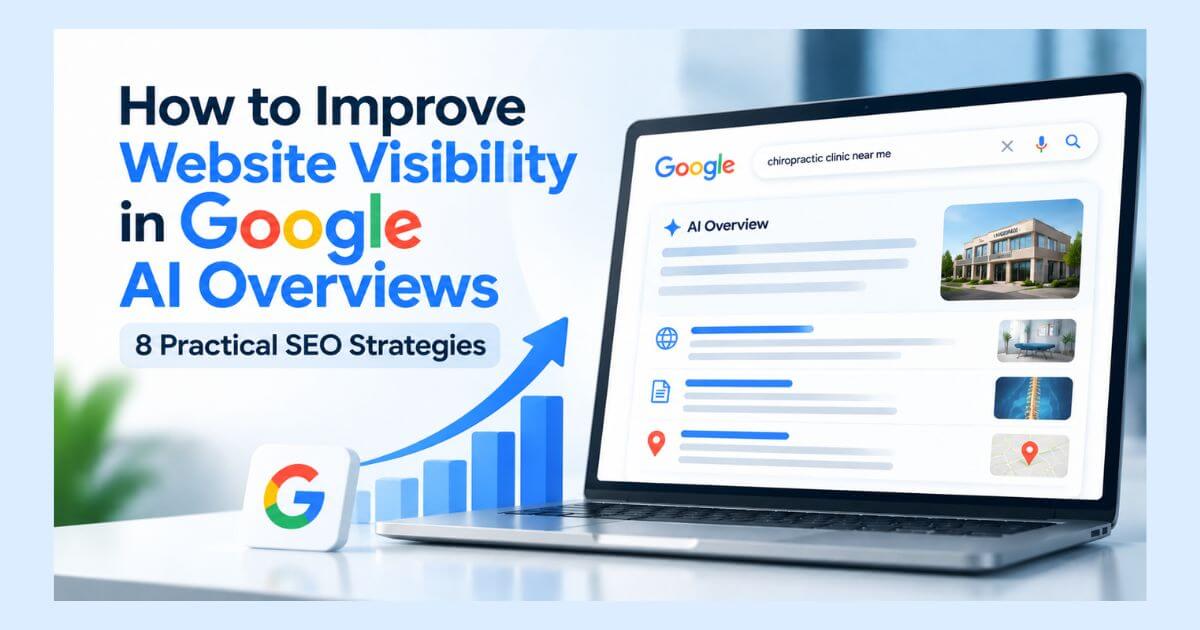
A chiropractic clinic in Wichita, Kansas, has a well-designed website, helpful treatment information, and an experienced practitioner. Its website attracts some visitors through traditional Google Search, but the owner wants to understand how the business can also be discovered through Google’s AI-generated search experiences.
The challenge is not simply getting a website mentioned by artificial intelligence. It is making the clinic’s information accessible, trustworthy, relevant, and useful when people search for answers.
This is where Google AI Overviews and established SEO practices intersect.
To improve website visibility in Google AI Overviews, focus on helpful original content, technical accessibility, clear business information, relevant internal linking, and reliable measurement. These practices can improve your website’s foundation for Google Search, although no strategy guarantees an AI Overview appearance.
What Does Website Visibility in Google AI Overviews Mean?
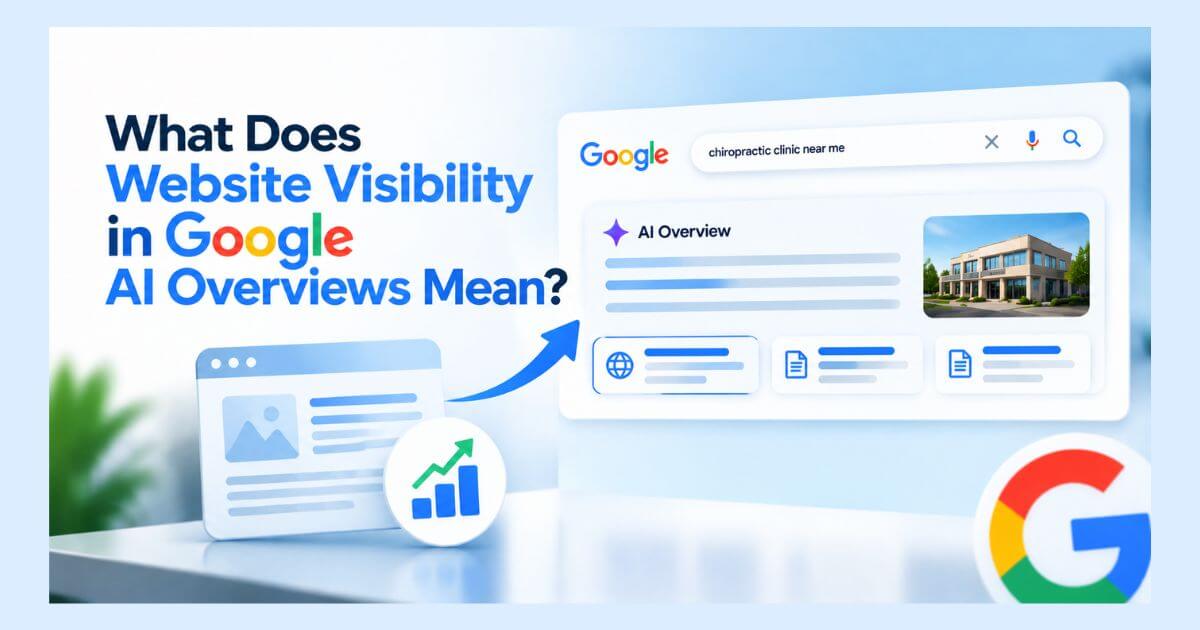
Google AI Overviews are AI-generated summaries that appear for selected searches when Google’s systems determine that an overview would be useful. They can include links to web pages that help users explore the subject further.
Visibility in this feature means that a website’s content is selected as a supporting link within an AI Overview.
This is different from ranking in traditional organic results. A page can appear in Google’s regular search results without being selected for an AI Overview.
Google’s official guidance confirms that existing SEO fundamentals remain relevant. To be eligible as a supporting link, a page must be indexed and eligible to appear in Google Search with a snippet. Eligibility, however, does not guarantee inclusion.
1. Publish Original Content That Provides Genuine Value
One of the most important steps is creating content that offers something useful beyond a generic summary of information already available online.
Google’s guidance for generative AI search emphasizes valuable, distinctive content that serves people.
Instead of writing a broad article that repeats common advice, address a specific problem with meaningful explanations, relevant examples, reliable evidence, and practical next steps.
For example, a Kansas chiropractic practice could publish a resource explaining what prospective patients should ask when evaluating chiropractic services. The content should reflect appropriate professional expertise, avoid unsupported medical claims, and clearly distinguish general information from individual medical advice.
For your own website, Nurul Rovan can apply the same principle by publishing practical SEO resources that explain technical problems, demonstrate diagnostic processes, and help business owners make informed decisions.
Action: Review your important pages and identify where you can add original insight, specific examples, or useful information that competing pages do not adequately provide.
2. Answer Important Questions Clearly and Completely
People often search for information because they have a specific question or decision to make.
Your content should answer the central question early, then explain the details readers need to understand the answer.
For example, an article about indexing problems could begin by explaining that pages may remain unindexed because of crawling restrictions, indexing directives, canonical selection, or Google’s assessment of their usefulness.
The article can then explain how to diagnose each possibility.
Use descriptive H2 and H3 headings, concise explanations, relevant examples, and supporting evidence. Avoid forcing every paragraph into a short answer or adding repetitive FAQ sections merely to target more keywords.
Clear organization improves the reading experience and helps users find relevant information quickly. It does not independently guarantee AI Overview citations.
Action: Check whether readers can understand your main answer without searching through several paragraphs of unrelated background.
3. Strengthen Technical SEO and Indexing Eligibility
Even valuable content may have limited search visibility if technical problems prevent Google from accessing or processing it.
Review the technical foundation of your website.
Check that:
- Important pages can be crawled by Googlebot.
- Unintended noindex directives are removed.
- Canonical tags identify appropriate preferred URLs.
- Important internal links work correctly.
- Redirects lead to relevant destinations.
- Essential content is available in an accessible format.
- Your website works reliably across devices.
Use Google Search Console to investigate indexing issues and Google PageSpeed Insights to evaluate page performance.
For example, if a service page on a Kansas business website is accidentally marked noindex, resolving that problem is more important than rewriting its headings to target AI search.
Google does not require special AI Overview schema, separate AI text files, or a unique optimization system to make a page eligible for these features.
Action: Fix confirmed technical barriers before spending time on speculative AI optimization techniques.
4. Build Clear Business Entities and Consistent Information
Entity-based SEO helps establish clear relationships between a business, its services, its expertise, its people, and its location.
For a local business, these relationships might look like:
Business → Practitioner or Team → Services → Location → Relevant Customer Needs
For a Kansas chiropractic practice, important details may include the clinic’s name, practitioner information, actual location, available services, and accurate contact information.
For Nurul Rovan, the corresponding professional identity is:
Nurul Rovan → SEO Consultant → AI Search Optimization Specialist → Kansas Businesses → Search Visibility Consulting
Keep these relationships clear across your website. Ensure that your About page accurately describes your expertise and that service pages explain what you offer.
Use structured data when appropriate, but make sure it accurately reflects visible page content. Structured data can help Google interpret information; it cannot force Google to select your website for an AI Overview.
Action: Review your About page, service pages, author information, and relevant business profiles for accuracy and consistency.
5. Develop a Strong Topical Authority Through Internal Linking
A single article rarely answers every question a reader may have about a complex topic.
Build related content around distinct search intents and connect those articles through useful internal links.
For example, an AI Search Optimization content cluster could include:
- What Is AI Search Optimization and How Does It Work?
- What Are Google AI Overviews and How Do They Work?
- How to Improve Website Visibility in Google AI Overviews
- How to Measure AI Search Visibility
- How Entity-Based SEO Supports AI Search
Each article should serve a different purpose. Avoid publishing several articles that repeat the same explanation with slightly different titles.
Use descriptive anchor text that tells readers what they will find when they follow a link.
Action: Link this article to your related educational guides and, where appropriate, to your AI Search Optimization Expert Kansas service page.
6. Demonstrate Expertise, Accuracy, and Trustworthiness
AI-generated search experiences make reliable information especially important for subjects where accuracy affects decisions.
Google’s people-first content guidance encourages publishers to demonstrate expertise, explain who created the content, provide reliable information, and offer meaningful value beyond what is already available.
For your website, practical steps include:
- Displaying an accurate author name and biography.
- Linking to relevant professional information.
- Citing authoritative sources for factual claims.
- Updating outdated information when necessary.
- Distinguishing verified facts from examples and opinions.
- Avoiding exaggerated claims about rankings or AI citations.
For healthcare-related examples, use reputable medical sources and avoid presenting general information as a diagnosis or individualized treatment recommendation.
E-E-A-T is a useful framework for evaluating content quality and trust, not a score that guarantees an AI Overview appearance.
Action: Review whether readers can identify the author, understand the basis for important claims, and assess the reliability of the information.
7. Support Your Content With Useful Images and Structured Data
Text is central to explaining a topic, but supporting media can improve the reader’s understanding when it adds genuine value.
Use relevant diagrams, screenshots, charts, or original illustrations to clarify complicated concepts. Provide meaningful image alt text where appropriate.
For structured data, select types that accurately describe the page, such as Article, BlogPosting, or relevant business markup when applicable.
Validate supported structured data with Google’s Rich Results Test and ensure that the markup matches the visible content.
Do not add schema simply because you believe it is an AI Overview ranking factor. Google explicitly states that there is no special schema.org markup required for inclusion in AI Overviews or AI Mode.
Action: Add supporting media or structured data only when it improves understanding, accurately describes the page, or supports an applicable search feature.
8. Measure Google AI Overview Visibility and Improve Over Time
Optimization should be guided by evidence rather than assumptions.
Google Search Console provides a Generative AI performance report for eligible websites. As of August 31, 2026, Google has rolled out this report worldwide.
The report includes impressions from Google AI Overviews and AI Mode. Depending on the available data, you can examine performance by page, country, and date.
Use it to investigate:
- Which pages receive impressions in generative AI search features.
- Whether visibility changes over time.
- Which countries contribute impressions.
- Whether particular pages deserve further review.
You can also use Google Analytics to evaluate referral traffic, engagement, and qualified inquiries where measurable.
If the report is unavailable for your property, Google notes that the site may not have enough impressions in generative AI features.
Remember that impressions do not necessarily translate into clicks, leads, or customers. Review AI search metrics alongside traditional organic performance and business outcomes.
Action: Establish a baseline, monitor meaningful changes, and improve pages based on the evidence available rather than relying on occasional manual searches alone.
Common Google AI Overview Optimization Mistakes to Avoid
Avoid these common mistakes:
- Publishing large volumes of repetitive, low-value content.
- Adding keywords unnaturally to headings and paragraphs.
- Creating unnecessary pages for every minor query variation.
- Using structured data that does not match visible content.
- Blocking important pages from crawling or indexing.
- Assuming that an AI Overview citation can be guaranteed.
- Measuring success only by whether your brand appears in a few manual searches.
A sustainable strategy prioritizes people, original value, technical reliability, and measurable results.
Frequently Asked Questions
Can I guarantee that my website appears in Google AI Overviews?
No. Google selects AI Overview links algorithmically. Following SEO best practices can help make content eligible and useful, but inclusion is not guaranteed.
Does traditional SEO still matter for AI Overviews?
Yes. Google states that its AI search features rely on existing Search systems and established SEO fundamentals. Crawlability, indexing eligibility, useful content, and a good page experience remain important.
Does adding FAQ schema improve AI Overview visibility?
There is no special AI Overview schema requirement. Write useful FAQs when they genuinely help readers, and use structured data only where it accurately describes supported content.
How long does it take to improve AI Overview visibility?
There is no universal timeframe. Search systems need to discover and process content, and inclusion can vary by query and over time. Monitor available performance data instead of relying on a fixed deadline.
Can small businesses benefit from Google AI Overviews?
Potentially. Useful, relevant information can help small businesses reach people researching their services. Actual visibility depends on the query, competition, content, and Google’s systems.
Final Thoughts: Build Visibility Through Value, Not Shortcuts
Improving website visibility in Google AI Overviews begins with making your website genuinely useful and technically accessible.
Create original content, answer real questions, clarify your expertise, maintain consistent business information, and connect related resources through meaningful internal links. Then measure what happens and improve where the evidence points to an opportunity.
For Kansas businesses, this approach supports a stronger foundation for traditional search and evolving AI-powered search experiences.
Need Help Improving Your AI Search Visibility?
Nurul Rovan, an SEO Consultant and AI Search Optimization Specialist, focuses on connecting technical SEO, content strategy, entity clarity, and search visibility for businesses targeting Kansas markets.
If you want to understand how these areas can work together on your website, explore AI Search Optimization Expert Kansas.
You can also learn more about Nurul Rovan and his approach to practical, research-driven SEO.
