A chiropractic clinic in Wichita, Kansas, may have a professional website, detailed treatment pages, and years of experience serving local patients. Yet when potential patients use Google or an AI-powered search tool to research chiropractic services, the clinic may struggle to get discovered.
Traditional SEO helps businesses improve their visibility in search results, but search behavior is expanding. People increasingly use AI-powered experiences to explore questions, compare options, and discover relevant information.
This creates a new challenge: how can a business make its expertise easier for search systems to find, understand, and present to the right audience?
AI Search Optimization is the process of improving a website’s accessibility, content quality, and clarity so its information can be discovered and understood across AI-powered search experiences. It builds on established SEO practices rather than replacing them.
For businesses in Kansas and beyond, understanding this relationship can help create a more resilient search strategy.
What Is AI Search Optimization?
AI Search Optimization focuses on helping search systems interpret a business, understand its expertise, and connect its content with relevant user questions.
These experiences include Google AI Overviews, Google AI Mode, and ChatGPT search.
Traditional SEO remains essential because AI-powered search features use underlying search and retrieval systems to discover relevant information. Google confirms that established SEO fundamentals continue to apply to its generative AI search features.
AI Search Optimization brings several related disciplines together:
- Search Engine Optimization (SEO): Improves website accessibility, relevance, content quality, and organic search visibility.
- Answer Engine Optimization (AEO): Focuses on providing clear, useful answers to specific questions.
- Generative Engine Optimization (GEO): Addresses visibility and content discovery within generative AI search experiences.
- Entity-Based SEO: Clarifies relationships between a business, its services, expertise, people, and locations.
These approaches overlap. They are not separate ranking systems with guaranteed outcomes.
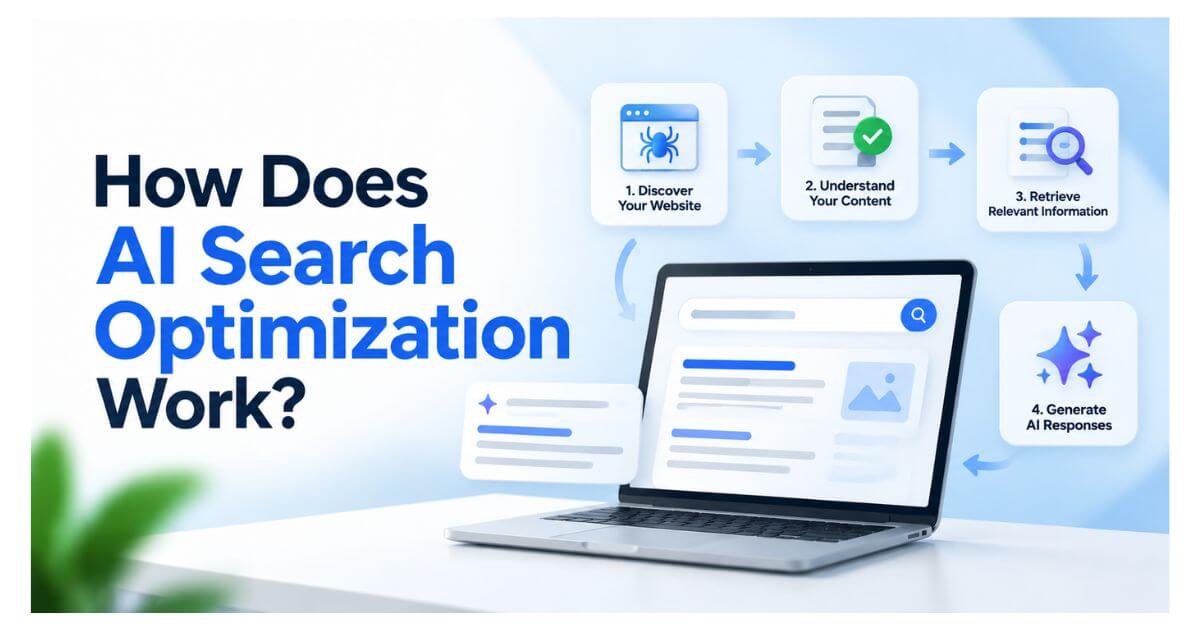
How Does AI Search Optimization Work?
AI-powered search experiences can retrieve information from relevant sources, interpret a user’s question, and generate a response that may include links to supporting websites.
The exact process varies by platform, but several important stages explain how a website can contribute.
1. Search Systems Discover and Access Your Website
Before eligible website content can be considered for many search experiences, the relevant systems need to discover and access it.
Technical SEO supports this process through crawlable pages, appropriate indexing directives, useful internal links, and reliable website performance.
For example, a Kansas chiropractic clinic might publish a detailed page about its services. If the page is accidentally blocked from crawling or contains an unintended noindex directive, its discoverability may be limited.
A technically accessible website provides a stronger foundation for search visibility, although accessibility alone does not guarantee indexing.
2. Content Helps Systems Understand the Business
Search systems need to interpret what a page explains and how it relates to a user’s question.
Clear headings, descriptive language, accurate information, and logical page organization make that interpretation easier.
Consider a chiropractic clinic that publishes a page explaining its services, practitioner qualifications, location, and appointment process.
When these details are accurate and clearly presented, readers can understand what the clinic offers without having to piece together information from unrelated pages.
The objective is not to write for machines at the expense of people. It is to communicate expertise clearly enough that both readers and search systems can interpret the information.
3. Relevant Information May Be Retrieved for a User’s Question
AI-powered search may investigate related aspects of a question rather than rely on a single matching phrase.
Someone researching a local chiropractic clinic might want to understand available services, practitioner qualifications, appointment arrangements, and location.
A website that answers these questions with relevant, reliable information may provide useful material for search systems to consider.
However, the selection of sources depends on the platform and its systems. No content structure guarantees that a particular website will be cited.
4. AI Search Experiences Generate Responses
Some AI-powered search experiences combine retrieved information into a synthesized response and provide links to relevant sources.
For website owners, the goal is to publish information that is useful, accurate, distinctive, and accessible.
Google explains that pages must meet the relevant Search eligibility requirements to appear as supporting links in AI Overviews or AI Mode. Even then, inclusion is not guaranteed.
This is why sustainable AI Search Optimization starts with strong SEO fundamentals rather than shortcuts designed to manipulate AI responses.
Five Essential Strategies to Improve AI Search Visibility
1. Create Helpful, Specific, and Original Content
Answer genuine audience questions with enough detail to solve the underlying problem.
A Kansas chiropractor, for instance, should provide accurate explanations of relevant services rather than publish multiple pages containing nearly identical descriptions.
Add meaningful context, relevant expertise, and clear next steps. Avoid repeating generic information simply to increase word count.
2. Strengthen Your Business Entity Information
Entity-based SEO helps clarify who a business is, what it does, whom it serves, and where it operates.
For a local business, keep its name, address, phone number, service descriptions, and practitioner information accurate wherever those details appear.
Use appropriate structured data when relevant, ensuring that it reflects the visible page content. Schema markup can support understanding and eligibility for certain search features, but it does not guarantee AI citations.
3. Make Important Information Easy to Find
Organize your website around meaningful topics and user needs.
Use descriptive headings, relevant internal links, and clear navigation to connect related information.
For example:
Chiropractic Clinic → Services → Treatment Information → Appointment Details
This structure helps visitors navigate the website and provides clearer relationships between its pages.
4. Maintain Strong Technical SEO Fundamentals
Review crawling, indexing, canonical tags, redirects, mobile accessibility, and page performance.
Important content should be accessible in a format search systems can process. Where JavaScript is used, verify that essential information is available after rendering.
For ChatGPT search visibility, website owners should also review OpenAI’s publisher guidance on allowing OAI-SearchBot to access content intended to appear in ChatGPT search results.
5. Measure Results and Improve Continuously
Monitor Google Search Console for impressions, clicks, indexing issues, and changes in search performance. Use analytics data to understand whether organic visitors engage with your content or become qualified leads.
For AI search, assess relevant referral traffic and qualified inquiries where measurable. Manual checks of AI responses can provide additional observations, but individual results are not a reliable measure of overall visibility.
Focus on meaningful business outcomes rather than chasing mentions or citations alone.
AI Search Optimization vs. Traditional SEO
| Traditional SEO | AI Search Optimization |
| Focuses on organic search visibility | Extends the focus to AI-powered discovery experiences |
| Optimizes technical accessibility and relevant content | Relies on the same fundamentals while emphasizing clear, useful information |
| Measures clicks, impressions, rankings, and conversions | Also considers measurable AI-related referrals and qualified inquiries |
| Supports search engine discovery | Supports discovery across evolving search interfaces |
These approaches are complementary. AI Search Optimization is not a replacement for traditional SEO.
How Nurul Rovan Approaches AI Search Optimization
Nurul Rovan is an SEO Consultant and AI Search Optimization Specialist who focuses on connecting technical website health, useful content, local relevance, and entity clarity.
For businesses targeting Kansas, this means understanding the business first, identifying how potential customers search, reviewing the website’s technical foundation, and prioritizing improvements according to their likely value.
For a chiropractic practice, that may involve reviewing service-page quality, practitioner information, local search signals, internal linking, and the accessibility of important website content.
The approach is research-driven rather than based on promises of guaranteed rankings or AI Overview placements.
Final Thoughts: Build a Stronger Foundation for AI-Powered Search
Search behavior is evolving, but the fundamentals of helping people find reliable information remain important.
Businesses that invest in accessible websites, original content, accurate entity information, and clear internal linking can establish a stronger foundation for traditional and AI-powered search.
The most effective approach is not to chase every new AI optimization trend. It is to understand your audience, communicate your expertise clearly, and continuously improve the experience your website provides.
Ready to Explore AI Search Optimization for Your Business?
If your website needs a clearer strategy for AI-powered search visibility, explore AI Search Optimization Expert Kansas — Nurul Rovan.
Learn how technical SEO, content strategy, and entity-focused optimization can work together to support your business’s search visibility.
Frequently Asked Questions
Is AI Search Optimization different from SEO?
AI Search Optimization focuses on discovery across AI-powered search experiences while building on established SEO practices. Technical accessibility, useful content, and clear information remain important.
What are AEO and GEO?
AEO stands for Answer Engine Optimization, while GEO stands for Generative Engine Optimization. Both terms describe approaches to improving how content can be discovered or used in answer-oriented and generative search experiences.
How can a business appear in Google AI Overviews?
Start by following Google’s established SEO best practices, ensuring important content is accessible and eligible for Search, and publishing useful, reliable information. No specific optimization guarantees inclusion.
Does AI Search Optimization help local businesses?
It can support local discovery by improving website accessibility, business information consistency, service descriptions, and the clarity of relationships between a business and its location. Results depend on multiple factors.
Does structured data guarantee AI citations?
No. Structured data should accurately represent visible content and support an overall SEO strategy. It does not guarantee rankings, AI Overview inclusion, or citations.
