You have built your business, invested in your services, and worked hard to earn your customers’ trust. But when someone searches Google for the services you offer, does your business appear—or do they find your competitors first?
For many small business owners, this is a frustrating challenge. Having a professional website does not automatically mean potential customers can find it.
That’s where an SEO expert can make a difference.
An SEO expert helps a small business improve its visibility in search engines through website audits, keyword research, technical SEO, content optimization, Local SEO, Google Business Profile improvements, and ongoing performance analysis. The goal is to attract relevant visitors and create more opportunities for customer inquiries and business growth.
However, effective Search Engine Optimization (SEO) involves much more than adding keywords or chasing rankings.
I’m Nurul Rovan, an SEO Consultant and AI Search Optimization Specialist focused on research-driven search strategies, particularly for businesses targeting Kansas, USA. I believe the starting point of effective SEO is understanding the business, its customers, and the problems preventing it from being discovered online.
In this guide, you’ll learn what an SEO expert actually does, how SEO supports small businesses, and what to consider before hiring professional help.
Why Does a Small Business Need an SEO Expert?
Small businesses often compete with established companies, local competitors, and online directories for attention in search results.
Imagine someone in Wichita searching for a nearby electrician, or a homeowner in Topeka looking for a landscaping company.
Those searches represent opportunities for businesses offering relevant services.
But search engines need to discover, understand, and evaluate the available information before presenting results.
An SEO expert helps businesses improve that information and the technical foundation supporting it.
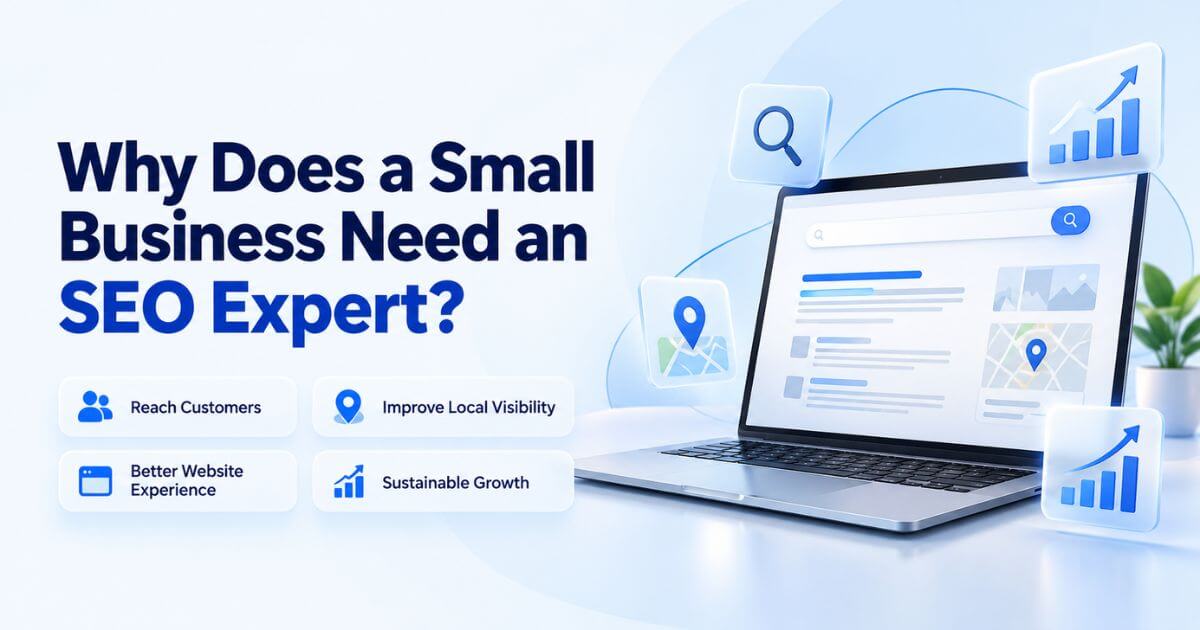
Here are four important reasons small businesses invest in SEO.
1. Reach Customers Searching for Your Services
SEO focuses on connecting a business with people already looking for related products, services, or information.
Unlike interruptive marketing, search optimization helps businesses become discoverable when a potential customer expresses an interest through a search.
2. Improve Local Business Visibility
Businesses serving specific areas benefit from making their services, locations, and business information clear.
Local SEO can help support discovery through Google Search and Google Maps.
3. Build a More Useful Website
SEO improvements often benefit website visitors as well.
Clear navigation, helpful service information, mobile usability, and well-organized content make it easier for customers to understand a business.
4. Support Sustainable Marketing Growth
Organic SEO can create opportunities for visibility without paying for each organic click.
However, SEO requires resources, ongoing maintenance, and realistic expectations. Rankings and traffic can change, and results are never guaranteed.
What Are the Main Responsibilities of an SEO Expert?
An SEO expert’s work generally involves several connected activities.
The exact responsibilities depend on a business’s website condition, industry, target locations, competition, and commercial goals.
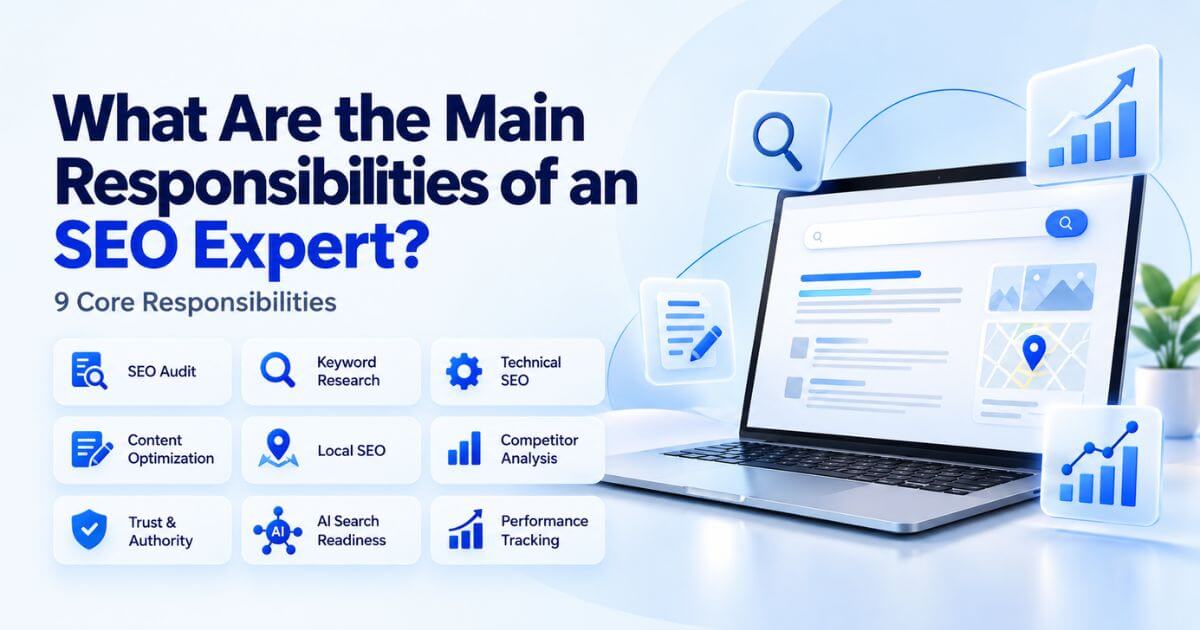
1. Perform a Complete Website SEO Audit
An SEO audit is often the starting point of a professional SEO strategy.
Before recommending improvements, an SEO expert examines the website to understand what is working and what might be limiting its performance.
An audit may cover:
- Website crawlability and indexation
- Technical errors and broken links
- Page titles and heading structure
- Keyword targeting and search intent
- Existing content quality
- Internal linking and website architecture
- Mobile usability and page performance
- Competitor visibility and content gaps
For example, a small plumbing company might offer several services but have only one general page describing everything.
An audit could identify the need for clearer service information or dedicated pages that genuinely address different customer needs.
The purpose is not to generate a report filled with technical terminology.
A valuable SEO audit identifies the problems that matter and explains which improvements deserve attention first.
2. Research Keywords and Understand Customer Search Intent
Keyword research helps an SEO expert understand what potential customers are searching for.
But search volume alone does not determine whether a keyword is valuable.
An SEO professional also considers search intent, relevance, competition, and commercial value.
Consider a roofing company in Overland Park, Kansas.
Potential customers might search for:
- Roofing contractor Overland Park KS
- Roof repair near me
- Signs of roof damage
- How much does roof repair cost?
- Residential roof inspection services
These searches reflect different stages of the customer journey.
Someone looking for roof repair may be ready to contact a contractor. Someone researching signs of damage may still be evaluating whether professional help is necessary.
An SEO expert identifies these differences and recommends the most appropriate content for each search.
This process is called search intent optimization.
Its purpose is to connect the right information with the right audience at the right stage of their decision-making process.
3. Improve Technical SEO and Website Performance
Technical SEO helps search engines access, crawl, and understand website content.
Even a website with useful information may experience visibility problems if important pages cannot be crawled or indexed correctly.
Technical SEO commonly involves:
- Reviewing indexing and crawlability
- Improving website architecture
- Evaluating Core Web Vitals
- Checking mobile usability
- Correcting redirect and canonical issues
- Reviewing XML sitemaps and robots.txt
- Strengthening internal linking
- Implementing appropriate structured data
For example, a service page might contain valuable information but have an accidental noindex directive.
That directive can prevent the page from appearing in Google’s indexed search results.
An SEO expert can investigate the problem and recommend the appropriate correction.
Technical SEO is important because it creates a foundation for content and other search optimization activities.
Businesses needing more detailed assistance can explore Technical SEO optimization services.
4. Optimize Website Content and Service Pages
Search engines aim to provide results that address the user’s needs.
An SEO expert helps businesses create and improve content that communicates their services accurately and answers relevant customer questions.
On-page SEO may involve improving page titles, headings, service descriptions, meta descriptions, image alternative text, internal links, and calls to action.
For example, a small accounting firm may offer bookkeeping, tax preparation, and payroll services.
Rather than using one vague page that barely explains these services, the website may benefit from distinct content describing each offering.
Each page should provide meaningful information about the service, who it helps, and how a potential customer can take the next step.
An SEO expert also looks for opportunities to answer related questions through educational content.
Useful content should demonstrate genuine knowledge and relevance rather than repeat the same keywords unnaturally.
5. Improve Local SEO and Google Business Profile Visibility
Local SEO is especially valuable for small businesses that serve customers in particular geographic areas.
An SEO expert evaluates how clearly the business communicates its location, services, and relevance to nearby customers.
This often involves Google Business Profile optimization, local keyword research, accurate business details, relevant service-area information, local competitor analysis, and review management practices.
For example, a chiropractic practice in Lenexa may want potential patients to discover its clinic when searching for chiropractic services nearby.
A Local SEO strategy might involve improving its website’s clinic information, ensuring its Google Business Profile accurately represents the practice, and developing useful service-related content.
According to Google’s local ranking guidance, local search results are primarily influenced by relevance, distance, and prominence.
That means Local SEO cannot simply overcome geographic distance or guarantee a top Google Maps position.
Effective optimization focuses on accurate business information and genuine relevance to the customer’s needs.
6. Analyze Competitors and Discover SEO Opportunities
Small businesses benefit from understanding which websites already appear for their most important searches.
Competitor analysis examines search visibility, content topics, website structure, and potential gaps.
For example, an SEO expert may discover that competing businesses provide useful answers about service costs, project timelines, and common customer concerns, while another business’s website barely addresses those topics.
That insight could lead to more informative service pages or educational articles.
The goal is not to copy competitors.
It is to understand customer expectations and identify opportunities to provide clearer, more useful information.
Competitor research should ultimately support decisions that align with the business’s own services, strengths, and priorities.
7. Build Trust Through Relevant Content and Business Information
Search visibility and business credibility are closely connected from a customer’s perspective.
People want to know whether a company is legitimate, relevant, and capable of providing the service they need.
An SEO expert can help identify opportunities to strengthen a website’s credibility through accurate business information, clear author attribution, genuine reviews, relevant qualifications, and authentic examples of completed work.
These elements should be supported by real evidence.
For healthcare-related businesses, including chiropractic practices, credibility is particularly important because content may influence decisions about health and treatment.
Medical information should be accurate, appropriately supported, and reviewed by qualified professionals when necessary.
An SEO strategy should never rely on invented testimonials, misleading claims, or fabricated professional credentials.
8. Improve Readiness for AI-Powered Search
Search behavior is evolving beyond traditional lists of website links.
People also use conversational search experiences and AI-powered tools to research questions, compare services, and discover businesses.
This makes clear business information and useful content increasingly relevant.
An SEO expert may work on Answer Engine Optimization (AEO), Generative Engine Optimization (GEO), and AI Search Optimization alongside traditional SEO.
These activities can include improving content structure, strengthening entity relationships, clarifying business services, using descriptive headings, and ensuring important information is available in accessible text.
For example, a business website should clearly communicate:
- Who operates the business?
- What services does it provide?
- Who are its intended customers?
- Where does it operate?
- What evidence supports its expertise?
- How can customers learn more or contact the business?
These details help people and automated systems understand the business more clearly.
However, AI-powered search systems decide which information to retrieve, summarize, or cite. No SEO expert can guarantee inclusion in AI-generated answers.
Google also explains that its existing fundamental SEO best practices remain relevant for AI Overviews and AI Mode.
For a deeper understanding, explore AI Search Optimization for Kansas businesses.
9. Measure SEO Performance and Business Results
A professional SEO strategy should include ongoing performance measurement.
An SEO expert may use Google Search Console, Google Analytics, and other appropriate tools to evaluate organic search visibility and business outcomes.
Common performance indicators include organic clicks, impressions, click-through rate, keyword visibility, engagement, qualified inquiries, and conversions.
But not every metric carries the same business value.
For example, a small business receiving thousands of unrelated visitors may generate fewer inquiries than another business attracting a smaller number of highly relevant searchers.
This is why effective SEO should measure more than traffic.
The broader objective is to understand whether online visibility is helping the business attract the right audience and create meaningful opportunities.
How Does an SEO Expert Help Small Businesses in Kansas?
Kansas businesses operate in different geographic markets, industries, and competitive environments.
A chiropractic clinic in Lenexa does not necessarily face the same search challenges as a landscaping company in Wichita or an electrician in Topeka.
Each business has its own services, customer needs, and local competitors.
An effective SEO strategy accounts for these differences rather than using the same template for every website.
Nurul Rovan, an SEO Consultant and AI Search Optimization Specialist, focuses on helping businesses targeting Kansas strengthen their search presence through research-driven SEO strategies.
His target markets include Wichita, Topeka, Lenexa, Olathe, and Overland Park.
His approach connects several important elements: the business itself, its services, its intended customers, geographic relevance, search intent, and website performance.
This approach is especially relevant for service-based businesses that rely on customer inquiries, local discovery, and a trustworthy online presence.
Rather than focusing only on rankings, the objective is to identify meaningful opportunities through technical optimization, content improvements, Local SEO, and ongoing evaluation.
Business owners can learn more about this approach through SEO consulting services for Kansas businesses by Nurul Rovan.
Real-World Scenario: How SEO Could Help a Small Chiropractic Clinic
Imagine a chiropractic practice located in Olathe, Kansas.
The practice has an established website, but important service pages receive limited organic search visibility. Its Google Business Profile contains incomplete information, and potential patients cannot easily find answers to common questions about available services.
An SEO expert would begin by examining the website, search performance, local competitors, and business information.
The analysis might identify several opportunities:
First, improve the technical accessibility of important pages.
Second, clarify the clinic’s service information and location relevance.
Third, organize educational content around genuine patient questions, ensuring healthcare statements are supported by reliable information.
Fourth, improve the accuracy and completeness of its Google Business Profile.
Finally, monitor search visibility and relevant inquiries to evaluate whether the improvements are supporting the clinic’s goals.
This is a hypothetical example illustrating the SEO process, not a claim about a particular client or guaranteed results.
For chiropractic practices, the relationship between clinic identity, qualified practitioners, actual services, patient needs, location, and trustworthy information is particularly important.
The same overall method of research, prioritization, implementation, and measurement can be adapted to other small businesses.
What Does a Small Business SEO Strategy Look Like?
A structured SEO plan helps business owners understand what is happening and why particular improvements are recommended.
A typical process can be divided into five stages.
| Stage | SEO Activity | Purpose |
| 1. Business discovery | Understand services, customers, goals, and competition | Establish relevant priorities |
| 2. SEO audit | Analyze technical issues, content, keywords, and local visibility | Identify opportunities |
| 3. Strategy development | Prioritize improvements based on impact and available resources | Create a practical roadmap |
| 4. Implementation | Improve technical SEO, website content, and local search information | Address identified issues |
| 5. Measurement | Review visibility, inquiries, and other relevant performance data | Refine the strategy |
Not every business follows the same implementation schedule.
For example, a website with major indexing problems may need technical corrections before broader content development.
A technically healthy website with incomplete service information may benefit more from content and local search improvements.
This is why professional SEO begins with diagnosis rather than a fixed list of tasks.
Can a Small Business Owner Do SEO Without Hiring an Expert?
Yes. Small business owners can complete many foundational SEO activities themselves.
These include writing accurate service descriptions, maintaining current business information, creating useful customer FAQs, improving navigation, and learning the basics of Google Search Console.
However, some challenges require more advanced knowledge.
Complex indexing problems, technical website architecture, competitive keyword strategies, structured data issues, and large content projects may require specialized experience.
Hiring an SEO expert can help a business understand which tasks matter most and how to implement them efficiently.
The decision should depend on the owner’s technical knowledge, available time, business priorities, and budget.
How Long Does SEO Take to Work for a Small Business?
SEO results do not follow a guaranteed timeline.
Some technical corrections can be discovered and implemented relatively quickly, while meaningful improvements in competitive search results may take several months or longer.
Results depend on website condition, competition, content quality, existing visibility, implementation, and changes in search behavior.
A new small business website may require a different strategy from an established business with years of content and a strong local presence.
Business owners should look for clear milestones and measurable progress rather than guaranteed deadlines for reaching particular rankings.
How Much Does Small Business SEO Cost?
Small business SEO costs depend on the scope and complexity of the work.
A one-time SEO audit usually requires a different level of investment from ongoing consulting that includes technical improvements, keyword research, content planning, Local SEO, and performance reporting.
Important cost considerations include website size, industry competition, number of locations, existing technical problems, and the resources required for implementation.
Before agreeing to an SEO service, ask for a clear explanation of the proposed work, deliverables, reporting methods, and responsibilities.
A useful proposal should explain how the recommended activities relate to the business’s needs rather than simply promising more traffic.
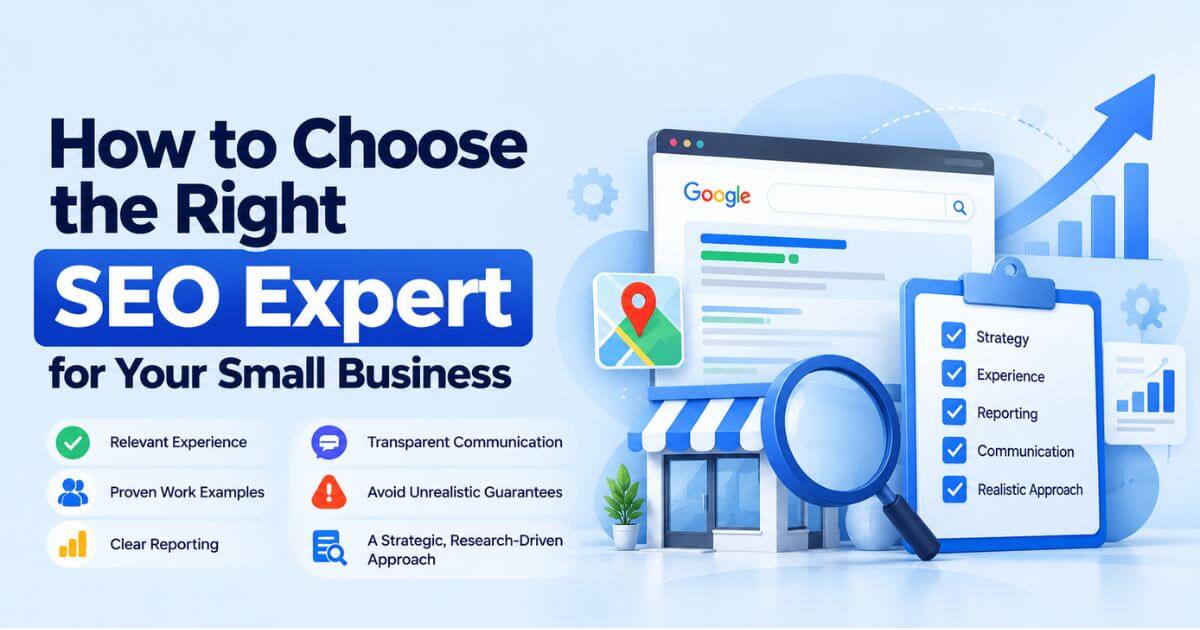
How to Choose the Right SEO Expert for Your Small Business
Choosing an SEO expert should involve more than comparing prices or reading promises about rankings.
Look for a professional who asks questions about your business before recommending solutions.
A reliable consultant should be able to explain how they research keywords, evaluate technical problems, approach Local SEO, develop content strategies, and measure outcomes.
You should also ask about relevant experience, work examples, reporting practices, and communication.
Be cautious of anyone offering guaranteed first-place rankings, fabricated review campaigns, or promises of guaranteed AI citations.
A good SEO consultant should help you understand the reasons behind their recommendations, not leave you dependent on unclear technical claims.
Final Thoughts: SEO Should Help Your Business Get Discovered by the Right People
An SEO expert does far more than optimize keywords or track Google rankings.
The work involves understanding your business, researching customer searches, identifying technical barriers, improving useful content, strengthening local search visibility, and measuring whether those efforts support your goals.
For small business owners, this means SEO should be approached as a long-term business activity rather than a collection of quick fixes.
An effective strategy begins with asking the right questions: Who are your customers? What services do they need? How do they search? What prevents them from discovering your business?
At Nurul Rovan, my focus is on connecting these questions with research-driven SEO strategies, transparent recommendations, and realistic expectations.
I work on SEO strategies for businesses targeting Kansas, including local service providers and chiropractic practices, with a focus on Local SEO, Technical SEO, content strategy, and AI Search Optimization.
If your small business needs a clearer understanding of its search opportunities, explore my SEO Expert Kansas services to learn more about the approach and available consulting support.
Your business deserves to be understood by search engines, discovered by relevant customers, and evaluated on the quality of the services it genuinely provides.
Frequently Asked Questions About SEO for Small Businesses
What does an SEO expert do every day?
An SEO expert may analyze search performance, investigate technical problems, research keywords, improve website content, evaluate competitors, monitor local visibility, and develop optimization recommendations. The exact activities depend on the client’s needs and the current stage of the SEO project.
Is hiring an SEO expert worth it for a small business?
Hiring an SEO expert may be worthwhile when organic search is relevant to the business’s customers and professional support can address important visibility problems. Its value depends on the investment, implementation, competition, and measurable business results.
Does SEO help small businesses get more customers?
SEO can help a business attract relevant visitors and create more opportunities for inquiries. Whether those opportunities become customers also depends on service quality, pricing, customer experience, and how effectively the website converts visitors into leads.
What is the difference between Local SEO and traditional SEO?
Traditional SEO addresses organic search visibility more broadly. Local SEO focuses on geographic relevance and discovery for businesses serving particular locations. It often includes Google Business Profile improvements, location-related content, and local business information.
Can an SEO expert improve Google Maps rankings?
An SEO expert can help improve an eligible business’s local search information, Google Business Profile, and broader local SEO strategy. However, Google Maps rankings depend on multiple factors, including relevance, distance, and prominence. Rankings cannot be guaranteed.
Do small businesses need AI Search Optimization?
AI Search Optimization can complement traditional SEO by improving how business information is organized and communicated across modern search experiences. Strong technical accessibility, useful content, and accurate business information remain essential. No special technique guarantees AI Overview placement.
What should I ask before hiring an SEO consultant?
Ask about the consultant’s process, relevant work experience, expected deliverables, technical capabilities, Local SEO approach, reporting methods, communication, and costs. Request realistic expectations and examples of how performance will be evaluated.
What is the most important part of small business SEO?
The most important starting point is understanding the business and its customers. Technical SEO, content, local visibility, and keyword research all matter, but the appropriate priorities depend on the business’s actual search opportunities and problems.
